Gold vs Brass: Visible Clues, Safe Checks, and When to Test
Compare gold and brass color, surface wear and hallmark clues. Learn why appearance alone cannot confirm gold content and when professional testing is needed.
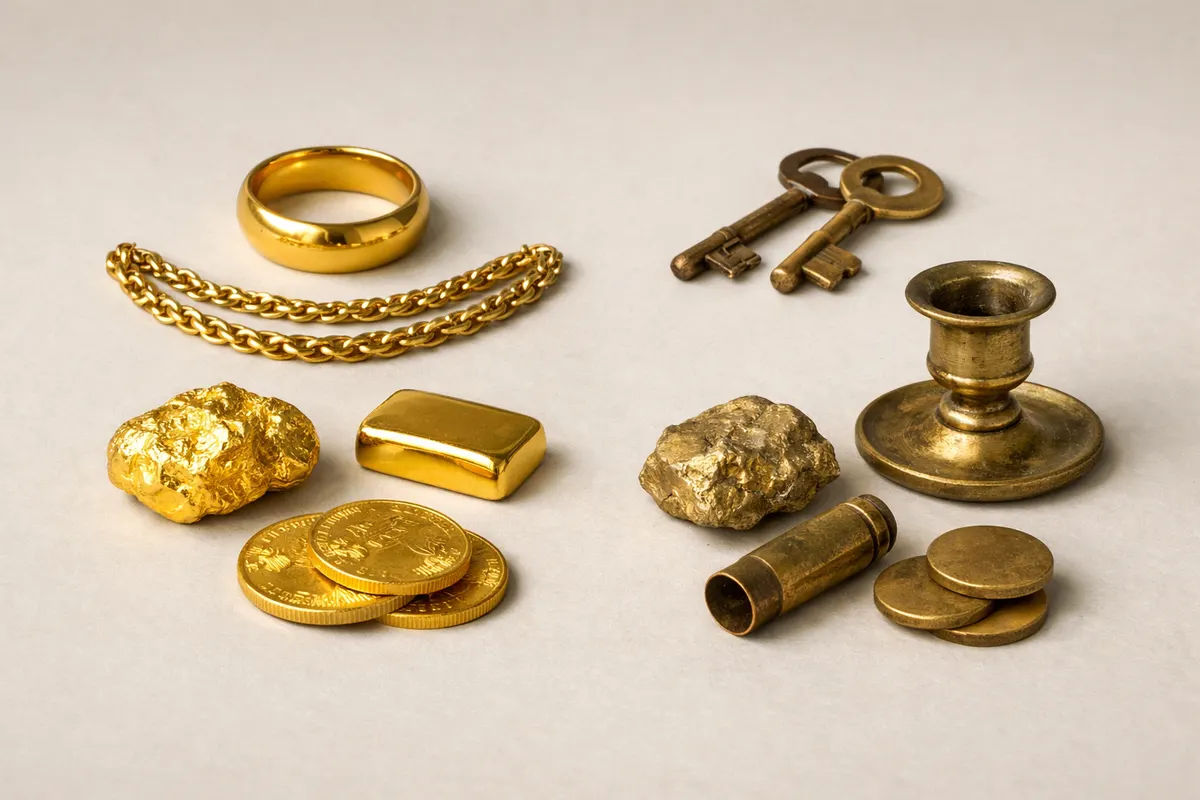
Quick answer: gold vs brass at a glance
Gold vs brass can look similar at a distance because both have warm, yellow tones, but there are reliable visible differences you can check without specialized equipment. Gold tends to keep a consistent warm yellow color over time, resists corrosion, and will usually show hallmarks or karat stamps on jewelry. Brass is an alloy of copper and zinc; it often shows greenish or reddish corrosion, lacquered surfaces, and darker wear where the base metal is exposed.
No single visual clue proves that an item is solid gold or brass. A combination of context (where it was found or purchased), visible wear, stampings, and simple non‑destructive tests—magnet, weight vs size, and a controlled density measurement—gives the strongest early evidence. When the evidence matters (sale, appraisal, insurance, or repair), professional material testing such as XRF or an assay is the only way to confirm purity and monetary value.
If you need a short checklist now: look for hallmarks, check for consistent color under natural light, feel the weight relative to size, do a magnet test, and document close photos of edges and worn areas. Use those clues to decide whether the item warrants professional testing.
What gold vs brass differences actually tell you
When people search 'gold vs brass' they usually want to know whether an object is valuable gold or a less‑valuable brass lookalike. The comparison involves three related questions: what the metal looks like, what its physical properties are, and what those clues imply about composition and value. Visual similarity does not equal equivalence: plated or gilt brass can look like gold until worn, and low‑karat gold alloys can appear very similar to brass in color and density.
Gold is a noble metal: it does not tarnish or form a green crust. That chemical stability is a strong clue, but only when you can inspect an unworn or older piece consistently exposed to moisture and air. Brass contains copper and will often develop reddish oxidation or green verdigris depending on exposure; many brass items are also lacquered to preserve the bright color, which can hide corrosion while still being a base metal beneath.
Physical properties—mass per unit volume (density), magnetic response, and sound—are objective measurements that help separate gold vs brass. Pure gold has a high density (about 19.32 g/cm3), while brass alloys usually sit around 8.4–8.7 g/cm3. However, jewelry often contains alloys, soldered joins, hollow chambers, or plating, which complicates density checks and makes professional tests the definitive route.
Visible and contextual clues to tell gold vs brass
Start with the context: where the item came from greatly changes the odds. An older family ring with a stamped hallmark found in a jewelry box is a different case than a loose, unmarked pendant found outdoors or sold in a flea market. Provenance and documented history do not prove purity but raise or lower the prior probability that the metal is gold.
Next, inspect color and wear under natural daylight. Solid gold tends to show a uniform warm yellow (or white/rose tones for alloyed gold) across thin edges and inside crevices. Brass often appears bright when new, but wear areas—especially where pieces rub together or at clasps—frequently reveal darker, reddish, or greenish tones beneath any surface coating.
Look closely for hallmarks and stamps. Common carat marks include 375 (9k), 585 (14k), 750 (18k) and 999 or 24K for pure gold; other regions use different symbols or numbers. A hallmark is evidence worth checking, but it can be forged and doesn’t guarantee purity without testing. Also inspect seams, solder joints, and the area where rings or clasps meet—these reveal construction methods and whether a plating job is present.
- Color consistency: uniform warm tone across hidden edges suggests gold; patchy discoloration or greenish corrosion suggests brass or plated brass.
- Weight vs size: gold feels heavier than an identically sized brass piece; if it seems light for its size, suspect brass or hollow construction.
- Magnet test: neither pure gold nor brass is magnetic; a pull toward a magnet indicates iron or ferrous inclusions, not gold.
- Hallmarks: look for karat stamps (375, 585, 750, 999) or regional assay marks; missing stamps don’t prove falsity, but clear stamps with readable fonts are helpful evidence.
- Wear and reversal: exposed base metal under worn plating, especially at edges and hinges, usually signals gold plating over brass.
Step-by-step non-destructive checks for gold vs brass
Assemble a small kit: a jeweler’s loupe or 10x magnifier, a small digital scale (grams precision), a tall graduated cylinder or narrow measuring cup for water displacement, a strong fridge magnet, a soft cloth and mild dish soap, and a camera or phone for close photos. These simple tools let you gather reproducible evidence without harming the object.
Step 1 — Photograph and document. Take close, well‑lit photos of obverse and reverse, edges, hallmarks, clasps, and any worn or discolored spots. Note where the item was found or acquired, whether it has a chain, and any paperwork. Clear photos will help a professional or appraiser quickly assess risk and next steps.
Step 2 — Visual inspection with magnification. Use the loupe to read any stamps and inspect edges. Look for plating lines, color differences at joints, and tool marks consistent with jewelry manufacture (hand‑forged pieces often differ from cast or stamped mass‑produced ones). Document what you see; plating typically peels or shows an even thin layer, while solid gold will show consistent color in thin cuts or worn areas.
- Step 3 — Magnet test: move a strong magnet across the object. A clear attraction suggests ferrous metals nearby or under plating; no attraction does not prove gold but helps rule out some base-metal cores.
- Step 4 — Weight and density: weigh the item in grams. Use water displacement to measure volume (record the displacement in milliliters = cm3) and compute density: density = mass (g) ÷ volume (cm3). Compare to expected ranges: brass ~8.4–8.7 g/cm3; pure gold 19.32 g/cm3; common gold alloys scale proportionally (14k ≈ 11.3 g/cm3, 18k ≈ 14.5 g/cm3). If your measured density is near brass ranges, suspect brass or a low‑karat alloy or hollow construction.
- Step 5 — Surface test without chemicals: gently clean a hidden area with mild soap and water to see underlying color. Do not scratch or use acids. If a different metal appears beneath a thin coating at a worn edge, plating is likely.
- Step 6 — Decide on professional testing: if the evidence supports a non‑trivial chance of gold and the item has monetary or sentimental value, arrange XRF analysis or a jeweler/assayer inspection. XRF is non‑destructive and provides metal composition by element; fire assay or cupellation is destructive but used historically for precise gold content when necessary.
Examples: common gold vs brass scenarios and what to do
Example 1 — Old signet ring found in a drawer: The ring has a worn interior stamp ‘585’ and consistent warm color inside the shank. The density test shows a value closer to 14 g/cm3 and magnet test is negative. These clues point toward 14k gold alloy. Recommended next step: document photos and arrange non‑destructive XRF or jeweler verification before sale or repair.
Example 2 — Bright yellow pendant bought at a market: No hallmarks, weight feels light for size, bright yellow lacquer visible on the surface, and a small chipped area shows a dull reddish metal underneath. These signs indicate brass with a protective lacquer or gold plating. Recommended next step: no expensive testing is needed unless you plan to sell it as gold; document photos and consider a local jeweler’s quick check if authenticity is important.
Example 3 — Antique watch case with green spots: greenish corrosion at hinges and a flaky texture suggest copper oxidation typical of brass or copper alloys. But some older gold‑filled cases used brass cores with thin gold layers and will show similar corrosion patterns. Recommended next step: look for stamps like ‘GF’ (gold filled) and schedule a density test or professional inspection if the watch has value beyond the base metal.
- Example 4 — Thin chain with wear at clasp: worn areas show a silvery base metal; this is likely gold‑plated brass over a base alloy. If the clasp area stamp shows no karat and weight is low, treat as plated.
- Example 5 — Coin or bullion‑like disc found outdoors: coins and medallions have standard weights and diameters; compare to published specs. For suspicious coins, do not scratch—record dimensions and weight and take photos for professional evaluation.
Limitations: what visible checks and photos cannot prove
Color, photos, and quick home tests provide useful clues but cannot confirm purity, authenticity, or monetary value. Plated items and gold‑filled pieces intentionally mimic the look and weight of solid gold; thin plating over dense cores or hollow interiors defeats density checks and visual inspection. Photos can mislead because lighting, camera white balance, and surface coatings change perceived color.
Density checks are powerful but have caveats. Many jewelry pieces are hollow, contain non‑metal parts, or are composite constructions (solder, cores, insets) that change mass and volume measurements. Measurement error in small volumes is common; without precise laboratory equipment and careful technique, density calculations can be off enough to misclassify low‑karat gold as brass or vice versa.
Avoid destructive tests. Scratch tests and home acid kits damage items, reduce resale value, and can be misused. Acid tests require skill, proper neutralization, and safety gear; they still produce only a surface reaction and can be fooled by plating. For anything with sentimental or material value, the safe, responsible choice is a non‑destructive professional test (XRF) or an accredited assay when absolute quantification is required.
- High‑confidence outcomes: clear hallmark + consistent density near expected karat range + no plating indications → good reason to pursue professional confirmation.
- Partial evidence: some matching clues but hollow or composite construction suspected → evidence points at best to a likely alloy; professional testing recommended before valuing.
- Uncertain outcomes: only color or a single photo available, or conflicting clues (e.g., heavy feel but no hallmark) → treat as unresolved and seek non‑destructive lab testing.
Related guides
Next step: collect your evidence, then compare with a professional
After you document photos, hallmarks, weight and any non‑destructive checks, consider one optional next step: run your evidence through a guided identification workflow at https://golddetector.app/ to organize photos and results for a professional review. The site can help you prepare images and measurements to share with an appraiser or assay service; it is an optional tool that complements, but does not replace, laboratory testing.


Frequently asked questions
Can I tell gold vs brass by color alone?
Color alone is not reliable. Lighting, lacquer, plating, and camera settings can make brass and plated items look like gold. Look for consistent color in hidden areas, hallmarks, and wear patterns in addition to color. If the item’s color remains the same under natural daylight and inside crevices, that increases confidence—but does not confirm purity. Professional testing is required for definitive identification.
Which safe home tests actually help identify gold vs brass?
Non‑destructive, informative home tests include the magnet check (gold and brass are non‑magnetic), weight comparison (gold feels unusually heavy for its size), and a controlled density measurement using a precise scale and water displacement. Clean a small hidden area with mild soap to reveal underlying color, and inspect stamps with a loupe. Avoid any scratch or acid tests at home; they can damage the item and give misleading results.
Why does brass turn green while gold does not?
Brass contains copper, which oxidizes and can form greenish compounds (verdigris) when exposed to moisture and certain chemicals. Gold is chemically inert and does not form that green corrosion. However, lacquered brass can hide corrosion until it flakes off, and some other base metals may produce different discolorations, so green coloration is a strong indicator of brass or copper content but not a formal proof.
Does brass have gold in it?
Brass is a copper–zinc alloy; its gold-like color does not mean it contains gold. A brass object may also have a separate plated surface. Appearance and a photograph cannot establish the metal composition or the purity of a coating, so keep those questions separate when comparing an item.
When should I get professional testing instead of relying on visuals?
Get professional testing when the item has monetary or sentimental value, when you plan to buy or sell based on metal content, or when evidence is mixed or unclear. Non‑destructive XRF testing at a reputable jeweler or assay lab gives elemental composition quickly and without damage. For legal or high‑value transactions, accredited assay or fire assay (for bullion) may be appropriate. Photographs and home checks are only first‑step evidence, not certifications.