Gold vs Pyrite: Visual Clues, Lookalikes, and Next Steps
Practical tips for gold vs pyrite ID: visible clues, quick photo checks, common lookalikes, and safe next steps before any lab or acid test.
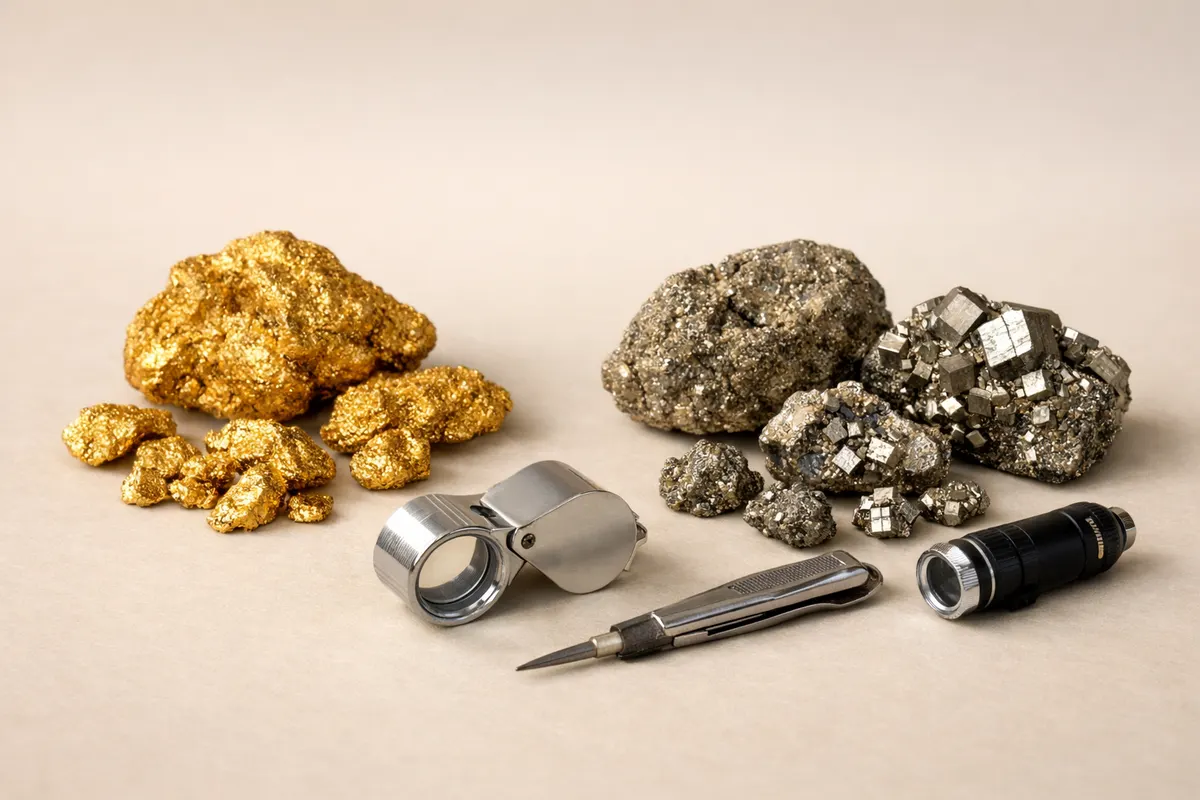
Quick answer: gold vs pyrite at a glance
If you’re trying to tell gold vs pyrite from a photo or a quick in-hand look, start with a few strong visual rules: gold appears buttery yellow, has a soft, metallic sheen that doesn’t sparkle into crystal faces, is malleable, and leaves a yellow streak. Pyrite (fool’s gold) often looks paler, brassy, or glittery because it forms small cubic or striated crystals that flash when light hits them and it usually leaves a darker, greenish-black streak.
From a distance or with a single low-quality photo you can often narrow a find to “likely gold,” “likely pyrite,” or “uncertain.” That classification is useful — treat it as a research note, not a final appraisal. For anything you value or might sell, follow up with non-destructive field checks (magnet, heft, simple streak) and, if still uncertain, a professional specific-gravity or XRF test.
- Gold: soft, warm yellow, malleable, solid metallic sheen, yellow streak.
- Pyrite: brassy or pale yellow, glittery/reflective from crystal faces, brittle, dark streak.
- If photo lacks scale, lighting, or close detail, call the result uncertain and collect better pictures.
What gold vs pyrite looks like and why the confusion happens
The confusion between gold and pyrite comes from an overlap in basic color: both can be yellowish and metallic. But the two materials are different minerals with distinct physical behaviors. Gold is a native metal — dense, soft, and malleable — while pyrite is an iron sulfide mineral that forms crystals and is relatively hard and brittle.
In jewelry and small finds the problem often appears as a thin coating, plating, or a mineral inclusion that mimics gold’s color. In rock and ore samples the same visual similarity can appear because pyrite forms sparkly faces that catch light differently than the smooth, oily sheen that characterizes gold.
Understanding what to look for in photos or at a glance reduces the chance of misidentifying a keepsake or a sample. This guide focuses on practical, low-risk checks you can do visually and with safe field methods, and it explains when a professional test is the right next step.
- Gold = native metal: dense, soft (malleable), uniform buttery-yellow color.
- Pyrite = mineral: brassy to pale yellow, crystalline faces, brittle, often sparkles.
- Appearance alone can be misleading—context (where it was found, associated minerals, and weight) matters.
Key visual and contextual clues to check first
Start with close-up photos or a loupe view. The single most useful visual clue is how the surface reflects light: gold gives an even, oily metallic sheen that flows across curved surfaces; pyrite shows multiple tiny flat faces and a glittery, sparkly effect when rotated under direct light. Magnified photos that show crystal edges or striations strongly favor pyrite.
Color tone matters but isn’t decisive by itself. Pure gold tends to be deeper, warmer yellow; pale, brassy, or greenish-yellow tones usually point away from pure gold and toward pyrite, chalcopyrite, or brass. Also look for signs of surface coating: peeling, flaking, or uneven color suggests plating or a mineral rind rather than native gold.
- Luster: gold = smooth, metallic, almost oily; pyrite = glittery with small flat crystal faces.
- Crystal habit: visible cubic or striated edges = pyrite; rounded, worn blobs or flattened sheet-like forms = possible gold or plated metal.
- Hardness hint (photo test): if the piece has deep scratches exposing a different color beneath, it may be plated metal; gold is soft and dents rather than scratches sharply.
- Streak (if you can test safely): gold leaves a yellow streak; pyrite leaves a dark gray to greenish-black streak on unglazed porcelain.
- Weight sense: gold is noticeably heavy for its size. If the object feels light for its bulk, it’s likely not solid gold.
- Context clue: geological setting, nearby finds, or source (e.g., river placer vs. mine tailings) shifts probabilities; photograph any surrounding matrix or soil.
- If you want a practical checklist you can print and take to a find, search for a gold vs lookalikes photo set to compare chalcopyrite, mica, and plated metals side by side.
Step-by-step workflow for photo checks and safe field tests
Work from least invasive to more conclusive tests. For photos: take multiple images with scale (a coin or ruler), even diffuse lighting, and close-ups showing surface detail and edges. A set of five photos — full object, two close-ups from different angles, a macro of any crystal faces or textures, and context showing where it was found — is often enough to make a confident preliminary call.
Once you have solid photos, add simple, low-risk field checks. A small magnet test (hold a strong magnet near the sample) can quickly identify magnetic iron minerals like magnetite or pyrrhotite; pyrite itself is not strongly magnetic but magnetic response rules out pure gold. A gentle heft check — comparing how heavy the piece feels to a known metal of similar size — is useful because gold’s high density stands out.
- 1) Photograph: include scale, diffuse lighting, and multiple angles; show any attached matrix or soil.
- 2) Visual magnification: use a loupe or macro photo to look for crystal faces, striations, or layered plating.
- 3) Magnet check: quick and safe; a strong pull suggests iron-bearing minerals, not gold.
- 4) Streak and scratch hints: if safe and permitted, a light streak test on unglazed porcelain can separate gold (yellow streak) from pyrite (dark streak). Avoid destructive tests on jewelry you care about.
- 5) Heft test: compare weight against a similar-size object; solid gold feels heavy for its size.
- 6) Record: keep your photos and observations as research notes. If still uncertain, consult a professional for non-destructive lab tests.
- For a stepwise instruction set you can follow later, consult a gold vs identification guide that walks through streak, magnet, and specific-gravity checks in order.
Examples
Found jewelry at a flea market: A thin, bright yellow pendant that bends slightly when pressed and shows a yellowish interior at a worn edge is likely gold-plated brass rather than solid gold or pyrite. Plating peels in thin sheets and often reveals a different metal underneath. Photos that emphasize worn edges and any hallmarks will help make this clear.
Sparkly rock from a creek: If you find glittering yellow specks in rock, and macro photos show many tiny cubic faces, that points strongly to pyrite crystals in a host rock. Pyrite commonly forms in seams and pockets and breaks with brittle fractures; gold in placer deposits tends to appear in flattened, flaky lumps rather than as geometric crystals.
Small nugget-shaped piece: A soft, rounded, heavy nugget that dents slightly under pressure and maintains an even, warm yellow color is likely gold. If the same-shaped item flakes or shows clear cleavage lines and sparkles in sunlight, it’s more likely a mineral like pyrite or chalcopyrite.
Found in electronics or costume jewelry: Many bright yellows come from brass, bronze, or gold-plating. Look for seams, solder points, or base-metal exposures. These items are not pyrite and not gold — plating and alloys are separate categories that require hallmark or acid tests to sort further.
- Flea-market ring with worn edge: photograph the worn area to check for plating vs solid metal.
- Beach pebble with yellow glitter: macro photos showing cubic faces → pyrite.
- Heavy smooth nugget from panning: even sheen and malleability → possible gold.
- Sparkly mineral in matrix: look for angular crystals and host rock — these favor pyrite or chalcopyrite.
Limitations
Photos and quick field checks narrow possibilities but rarely provide final proof. Lighting, camera white balance, scale ambiguity, coatings, and surface oxidation can all mislead. For example, chalcopyrite and certain brass alloys can mimic gold’s tone in photos; thin gold plating can hide a base metal core that only shows under wear or in destructive tests.
Some minerals that look like pyrite contain iron oxides or sulfides that change color as they weather, making their appearance variable over time. Likewise, tiny microscopic inclusions or microstructural differences require lab-grade tools (specific-gravity measurements, acid testing under controlled conditions, or XRF spectroscopy) to resolve with confidence.
Be cautious with destructive tests. Acid testing, filing, or other invasive methods can damage sentimental or valuable items and should be performed by a trained person or a trusted jeweler. When value or authenticity matters — for sale, insurance, or legal purposes — get a professional verification rather than relying on photos alone.
- High-confidence outcome: consistent visual cues + heft + non-magnetic response = good candidate for gold, but not proof.
- Partial confidence: photos show mixed clues (e.g., warm color but clear crystal faces) — treat as uncertain and gather more data.
- Low confidence: poor photos, no scale, or contradictory field tests — stop, document, and seek a professional check.
- When to stop DIY: if the object is valuable, historically important, or you’re unsure whether a destructive test is acceptable, consult a professional lab or jeweler.
Related guides
Ready for a second opinion? Use Gold Detector - Goldiva next
After you’ve checked color, luster, streak hints, heft, and photographed the item with scale, use Gold Detector - Goldiva to capture more visual data and compile your observations. Treat the app’s result as a research note — not a definitive appraisal — and arrange a professional test if the item is valuable or your results are uncertain.


Frequently asked questions
Gold vs identification guide: How can I check a ring I found at a thrift store?
Begin with non-destructive steps: photograph the ring with scale and good lighting, inspect worn edges for base metal showing, and look for hallmarks inside the band. Perform a magnet test; a pull suggests non-gold alloys or iron content. If the ring feels unusually heavy for its size, that increases the chance of solid gold. Avoid filing or acid tests on sentimental pieces; instead, bring clear photos and the item to a reputable jeweler for a quick, non-destructive check or a professional specific-gravity test.
What visual signs most reliably separate gold vs pyrite in photos?
The most reliable photographic signs are surface reflection and crystal structure. Gold shows an even, oily metallic sheen and rounded, malleable shapes; pyrite shows many small, flat crystal faces that glitter and often display cubic geometry or striations. Close-up images revealing sharp edges or repeated geometric patterns almost always indicate pyrite or another mineral rather than native gold. Include a macro shot and a side-view to show how the surface interacts with light.
Can a magnet ever be used to tell gold from pyrite safely?
Yes — as a preliminary, safe check. Pure gold is not magnetic, and most pyrite is only weakly magnetic or non-magnetic; however, other iron minerals that look like pyrite (for example, magnetite or pyrrhotite) are magnetic. A strong magnet that causes a noticeable pull rules out pure gold and points toward iron-bearing minerals or metal alloys. Use this as one part of your workflow, not as definitive proof.
If my rock looks glittery, could it be anything else besides pyrite?
Absolutely. Glittery or sparkly yellow tones can come from chalcopyrite (which is brassier and often tarnishes), mica coatings, weathered sulfides, or even brass fragments. For geological samples, examine the host rock and crystal shape: cleavage, color streak, and association with other minerals help separate these cases. If the find has economic or sentimental importance, save samples and get a lab or experienced mineralogist to test specific gravity or run an XRF before drawing conclusions.