Gold vs Mica: How to Compare Visible Clues Safely and Reliably
Compare gold and mica using flake layers, luster and weight clues. See why a yellow sparkle is not proof of gold and which observations need verification.
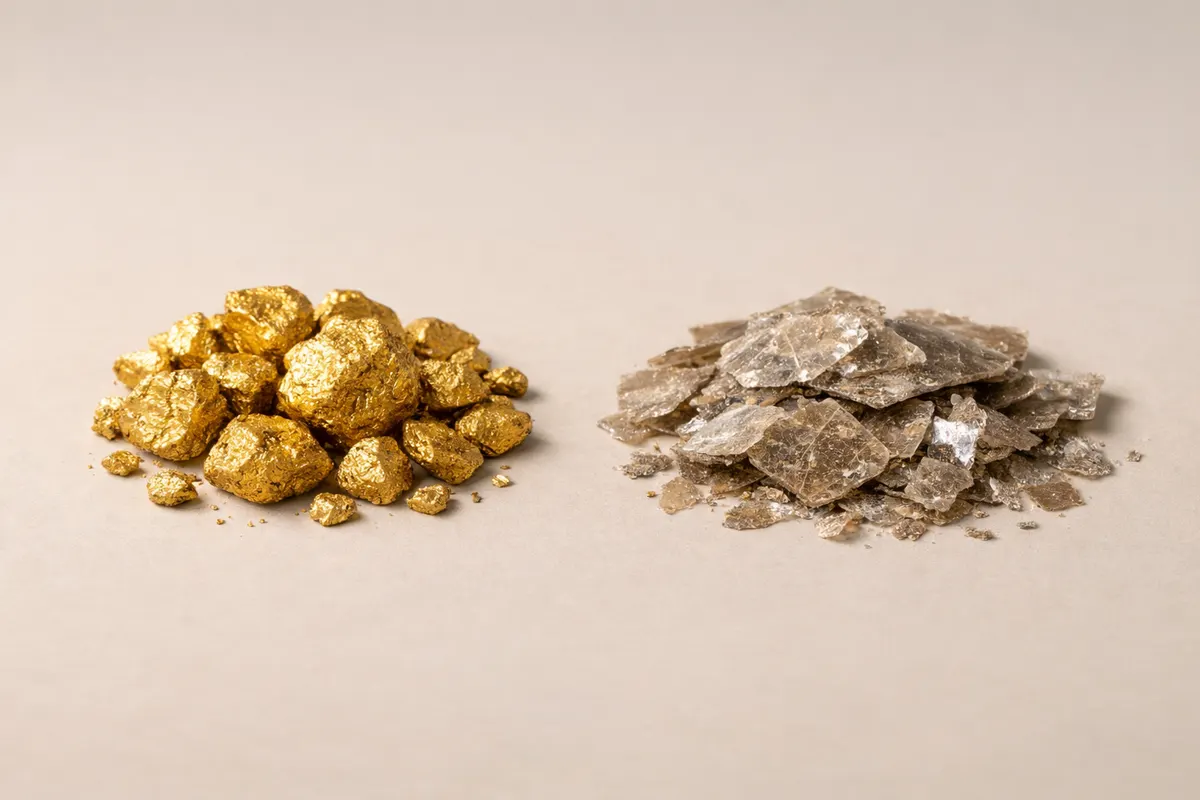
Quick answer: how to tell gold from mica at a glance
Gold vs mica are visually similar only in narrow circumstances: both can look yellowish and metallic in certain light, but the way they appear under close inspection differs in consistent ways. Gold is a dense, malleable metal with a warm, uniform yellow color and metallic shine. Mica is a group of sheet silicate minerals that form thin, flexible, often silvery or brownish flakes with a pearly to glassy sheen.
If you need an immediate, safe read from a photo or quick look, prioritize luster, texture and setting. Gold shows a continuous metallic luster and keeps the same tone across a flake or nugget. Mica shows a layered, flaky texture with visible cleavage planes; edges often look like stacked sheets and may shimmer differently from the center.
Quick non‑destructive checks: look for sheet‑like cleavage under a loupe, test for magnetic attraction (gold is not magnetic), and compare heft — a similar‑sized piece of gold feels heavier than mica. These clues point you toward or away from gold, but no sight test or photo can confirm purity or monetary value. When in doubt, document the specimen carefully and consult a professional for lab testing.
- Gold: uniform warm yellow, metallic luster, malleable, dense (heavy for size), no cleavage.
- Mica: flaky layered sheets, pearly/glassy sheen, flexible brittle flakes, lighter for same size.
- Safe quick checks: loupe inspection, magnet test, compare heft, and photograph scale and context.
What gold vs mica comparison actually tests for
When people compare gold vs mica they’re trying to answer two linked questions: is the visible piece a native metal (gold) or a silicate mineral (mica), and how confident can they be without laboratory tests? That comparison is not just about color. It is about how material properties — density, luster, cleavage, and malleability — show up visually and physically.
Gold is a native element with metallic bonding; it reflects light like a true metal and resists breaking into sheety layers. Mica group minerals (muscovite, phlogopite, biotite) form perfect basal cleavage, meaning they split into thin sheets. Those sheets reflect light differently from a solid metal surface: you’ll often see slightly varying tones across a single flake and thin transparent edges.
A practical comparison therefore tests observable traits that reflect those underlying properties. A photo or a short field check can push your confidence toward one identification or the other, but it cannot replace tests that measure composition (XRF, fire assay) when you need to know value, karat, or authenticity.
- Underlying trait: density — gold is very dense; mica is much lighter.
- Underlying trait: cleavage — mica splits into thin sheets; gold does not.
- Underlying trait: luster — gold has metallic luster; mica ranges from pearly to vitreous.
Key visible and contextual clues for gold vs mica
Color and tone: Gold has a warm, saturated yellow that remains consistent across the surface and when you tilt the piece. Mica can look yellowish in reflected light, especially some iron‑rich varieties, but its color shifts and often shows brown, silver, or greenish hues. Watch for tonal banding across a flake; that’s a mica sign.
Luster and reflection: Metallic luster on gold is bright and mirror‑like even on a small area. Mica’s sheen usually reads as pearly, silky, or glassy; reflections can appear striated because of the layers. Hold the specimen under directional light and tilt it — gold maintains a metallic shine; mica will show layered glints or internal reflections.
Texture and edges: Check the edge of the piece. Mica peels into paper‑thin sheets and often curls at the edges. You may see tiny striations parallel to the sheet. Gold forms cohesive grains or nuggets with smoother edges; a thin sliver of gold bends without flaking because gold is malleable, whereas a mica flake will break or split.
Weight and heft: If you can safely handle the piece, compare how heavy it feels for its size. Gold is unusually heavy (high specific gravity). A similarly sized mica flake will feel noticeably lighter. Use a small digital scale if accuracy matters; weigh comparable objects to calibrate your sense of heft.
Context and associations: Where you found the specimen matters. Mica commonly appears in metamorphic rocks, sheeted outcrops, and soil with visible mineral layering. Gold is often found in placer deposits, quartz veins, or associated with sulfide minerals. The surrounding rock, other mineral grains, or proximity to known placer streams are strong contextual clues.
Other quick checks: A magnet can rule out many iron‑rich lookalikes but won’t detect gold. Under a hand lens, look for cleavage planes and thinness (mica). Photograph the specimen with scale and in multiple lighting angles; these images help experts and apps make a first, cautious read.
- Tilt the piece in directional light: consistent metallic reflection suggests gold; layered glints suggest mica.
- Inspect edges: curled, sheeted edges → mica; smooth or bent edges → gold.
- Use a magnet to exclude magnetic sulfides; gold is non‑magnetic but magnetism doesn’t prove gold.
- Compare weight for size: gold will be noticeably heavier than mica.
- Record context: rock type, nearby quartz, stream gravels, and matrix can point toward gold or mica.
A safe step‑by‑step visual workflow for gold vs mica
Start with careful documentation. Before you touch or move the specimen, photograph it from multiple angles with a scale (ruler or coin) and a neutral background. Capture one photo in diffuse daylight and at least one under directional light so luster and layering show differently. Good images are essential if you later consult an app, forum, or professional.
Use simple, non‑destructive checks next. Examine the piece with a 10–20× loupe or magnifying glass: look for cleavage planes, layered structure, and edge behavior. Gently tap or flex a tiny, inconspicuous edge only if the object isn’t of obvious value; mica flakes may split or curl, gold will not flake. Avoid any scratching or cutting tests.
Perform lightweight physical checks: a magnet held near the specimen can rule out many iron sulfides and magnetite; a negative response doesn’t prove gold but a strong magnetic attraction rules gold out. If you can weigh the sample, note the mass relative to size — gold’s density is a strong visual proxy. Record all test results and images.
Compile context notes: where the sample came from, the surrounding host rock, and any nearby finds. If the specimen came from a miner’s known gold‑bearing area or a quartz vein, that increases prior probability for gold. If it came from a schist or sheeted metamorphic rock with visible mica layers, mica becomes more likely.
When to escalate: If visual and non‑destructive tests point to gold and you need confirmation of composition or value, seek professional testing. Options include XRF analysis, a jeweler’s or assayer’s inspection, or a fire assay for value determination. Do not attempt acid or destructive scratch tests at home; these can damage valuable items and produce hazardous waste.
- 1) Photograph with scale (multiple angles, diffuse and directional light).
- 2) Inspect with a loupe for cleavage, layering, and edge behavior.
- 3) Magnet test to exclude magnetic lookalikes; weigh for relative density.
- 4) Note geological and contextual clues around the find location.
- 5) If evidence suggests gold and you need certainty or value, get professional composition testing.
Practical examples: common gold vs mica scenarios
Jewelry fragment found in a drawer: Gold jewelry usually bears hallmarks, shows uniform metallic color, and bends without flaking. A scrap that flakes into thin sheets or shows layered peeling is likely mica or a mica‑containing composite. Photograph the piece near the hallmark and examine the edge for cleavage to distinguish metal from layered mineral inclusions.
Panned material from a stream: Tiny shiny flakes captured while panning can be gold, mica, or other minerals. Under a loupe, gold flakes look dense and maintain uniform color. Mica flakes usually appear translucent at the edges, may curl, and display pearly luster. Because placer contexts often include both minerals, weigh flakes of similar size to compare heft — gold will feel heavier.
Rock with visible yellowish flakes: If yellowish particles sit on or within a host rock, check the rock type. Schists and gneisses commonly host mica. Gold associated with quartz veins tends to be in pockets, seams, or small grains embedded in quartz, not distributed as many thin sheets. Look for other indicators like sulfide minerals or quartz strings.
Historic site finds: Old mining tailings can contain both gold fragments and mica from crushed rock. In these settings, small gold grains may appear rounded and dense; mica will be jagged, flaky, and often present in abundance. When working historic sites, document chain‑of‑custody if you intend to assay or sell material.
- Drawer jewelry: look for hallmarks and bending behavior; hallmarks + consistent metallic tone → gold.
- Stream pan: compare similar‑sized flakes for heft; mica flakes are lighter and curl at edges.
- Bedrock specimen: quartz veins and sulfides increase gold probability; layered schist suggests mica.
- Historic tailings: both may occur; quantity of flakes and host matrix are key context clues.
Mica flakes versus gold flakes: what to record
Photograph the same flake from more than one angle. These observations narrow a comparison; they do not establish gold content.
| Observation | Useful record | Caution |
|---|---|---|
| Layering | Whether thin sheet-like layers are visible | A photo may hide thickness |
| Luster | How the surface reflection changes with angle | A yellow sparkle alone is not proof of gold |
| Shape and context | Flake outline and the surrounding material | Color and location cannot authenticate the specimen |
What visual checks cannot tell you about gold vs mica
A photograph or casual visual check cannot confirm metal purity, karat, or monetary worth. Even when a specimen looks like gold, many alloys, coatings and mineral lookalikes mimic gold under typical lighting. Color and luster are strong signals but not proofs. If you need to know whether a piece is 14K gold versus 18K or gold‑plated, visual clues alone are insufficient.
Do not perform destructive home tests. Scratch tests that cut into a sample or household acids are risky for both you and the specimen. They can permanently damage an item’s value, release harmful fumes, or produce inaccurate results when performed without calibrated reagents. The responsible approach is to exhaust safe, non‑destructive checks and then seek professional analysis if required.
Even professional visual identification has limits. Experienced jewelers and geologists use microscopes, reference samples, and contextual knowledge to raise confidence, but composition tests such as XRF spectroscopy or fire assay remain the standard to quantify gold content and confirm identity. Treat any at‑home or photo‑based identification as provisional and report uncertainty when you document or share a possible gold find.
- Visual clues cannot determine karat, purity, or market value.
- Avoid destructive scratch or acid tests at home; these can damage items and mislead results.
- Professional nondestructive tests (XRF) or destructive assays (fire assay) are needed for certainty.
Related guides
Next step: use careful photos and an expert workflow
If your visual checks lean toward gold, collect clear scaled photos (directional and diffuse light), note the find context, and keep the specimen secure. For a structured, photo‑first workflow and guidance on safe next steps, visit Gold Detector - Goldiva at https://golddetector.app/. The site offers resources to organize images and evidence before you decide on professional testing.


Frequently asked questions
Can a photo alone prove a specimen is gold and not mica?
No. A well‑taken photo can show luster, layering, and edge detail that strongly suggest gold or mica, but it can’t confirm composition or purity. Lighting, camera settings and background can alter perceived color and shine. Use photos for an initial assessment and to document the specimen, then complement them with safe at‑home checks (loupe, magnet, heft) and, if necessary, professional testing such as XRF or assay for a definitive answer.
Is a magnet test enough to rule out non‑gold minerals?
A magnet test is a useful, non‑destructive exclusion tool: if a piece is strongly magnetic, it’s not native gold. Many iron‑bearing minerals and some sulfides attract a magnet, whereas gold does not. However, a negative magnet test does not prove the piece is gold — many non‑magnetic minerals and alloys can look goldlike. Treat the magnet as one quick filter among several observations, not as confirmation.
How does mica behave differently from gold when handled?
Mica flakes split into thin, flexible but fragile sheets and often curl or peel at the edges. They may appear translucent along thin edges and have a pearly or glassy sheen. Gold is malleable: thin pieces will bend rather than split and retain a continuous metallic surface without layered cleavage. When handling, mica often breaks into smaller flakes while gold deforms or dents if force is applied.
When should I send a specimen for lab testing?
Send a specimen for professional testing if you need to confirm composition, purity, or market value — for example when selling, insuring, or appraising. Also consider lab testing when visual checks and non‑destructive home tests strongly suggest gold but you need quantitative certainty. Choose accredited services that offer XRF for non‑destructive elemental screening or fire assay for an exact gold content measurement; reputable jewelers and assayers can advise which test fits your need.