

How to Recognize Gold Ore: Visual Clues and Next Steps
Learn how to recognize gold ore with practical visual clues, common lookalikes, and safe next steps. Know what photos can show and what needs lab verification.
Quick answer for how to recognize gold ore
How to recognize gold ore starts with careful observation: look for soft, metallic yellow tones, a bright metallic luster, and an unusually heavy feel for the specimen’s size. In many field cases visible gold appears as bright flakes, wires, or isolated grains in quartz or weathered rock. A clear photo can confirm those visible traits, but it cannot by itself prove composition, purity, or economic value.
Photos and close-up magnification are useful first passes. Take multiple images from different angles under natural light and with a macro-ready lens so you capture color, texture and grain relationships. These images help you spot gold’s typical smooth, malleable-looking surfaces and how it sits relative to host rock or sulfides—information that narrows possibilities, but does not replace laboratory analysis.
If you want a practical next step after observation, combine context (where the sample came from), visible clues, and simple, non-destructive checks before deciding whether to seek professional verification. For a focused comparison between gold and a common lookalike, see Gold vs Pyrite: Visual Clues, Lookalikes, and Next Steps (https://golddetector.app/blog/gold-vs-pyrite). For composition or grade, a certified assay is required.
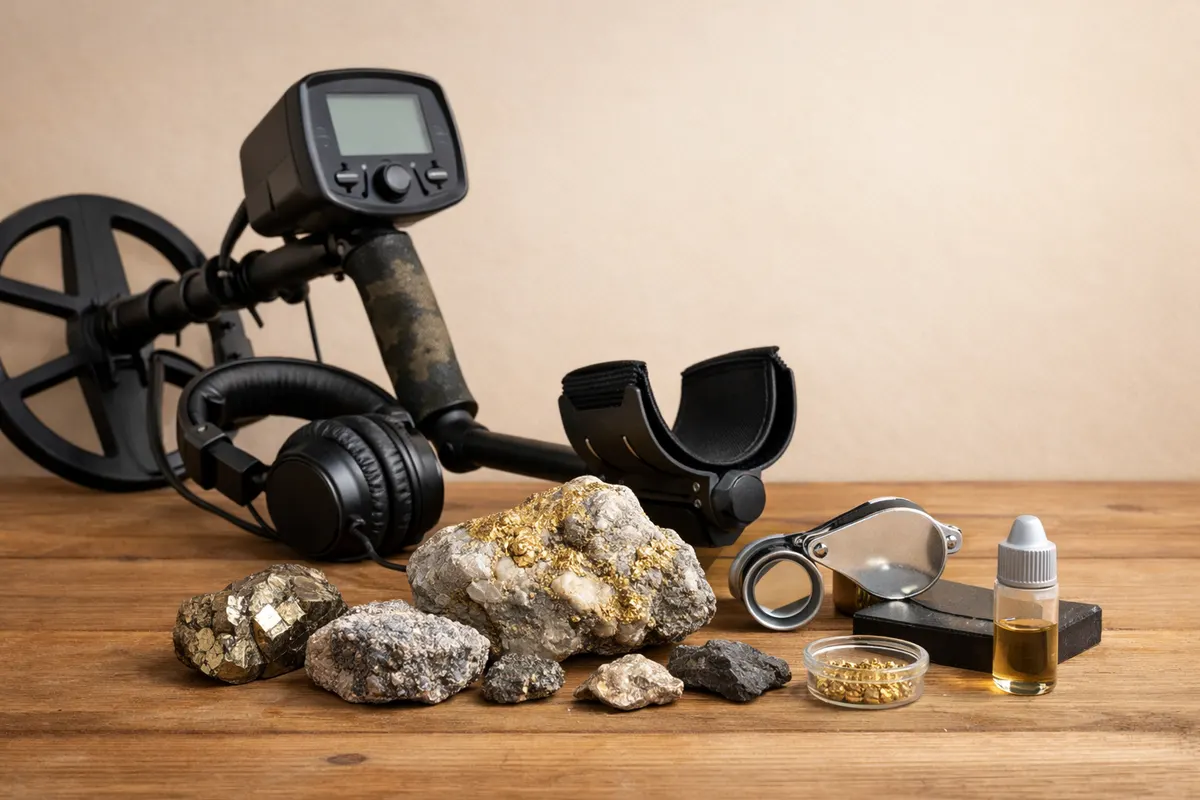
AI-generated illustration, not verified gold-bearing samples. A detector or pictured test bottle does not establish composition; avoid home chemical tests.
What recognizing gold ore means in the field
Gold-bearing rock contains gold, but “ore” has an economic meaning: material from which a valuable constituent can be extracted profitably under the relevant conditions. A yellow grain in quartz does not establish that the surrounding rock is ore. Recognizing a possible gold-bearing sample is a screening step; grade, scale of the deposit, recovery, and costs need separate evidence.
Visible gold usually indicates coarse, free gold that is easier to separate; when gold is bound to sulfides or finely disseminated in gangue minerals it will not appear as bright grains. That distinction matters because visible traits (color, luster, shape and association) can suggest free gold versus hidden gold, but only laboratory analysis confirms elemental composition and recoverability.
Context is essential. Host rock, vein textures, weathering patterns, and associated minerals (for example quartz veins, iron oxides or sulfide assemblages) all change the likelihood that a visible metallic grain is gold. Regional geology and local mining history provide further clues: abandoned workings, placer deposits downstream, or known mineralized belts increase the prior probability that a specimen contains gold. Authoritative overviews on gold occurrence and common geologies are helpful reference points: see the USGS gold overview (https://www.usgs.gov/centers/national-minerals-information-center/gold-statistics-and-information) and general mineral data at Mindat.org (https://www.mindat.org).
How to recognize gold lookalikes and real clues
When assessing a suspected sample, prioritize clues that observation or a camera can capture reliably. Color and luster, the way a grain reflects light, and how it sits within the rock are primary visual signals. Gold is a warm, metallic yellow and usually retains that color on fresh surfaces; dull or brassy tones more often point to iron sulfides or other metallic minerals.
Grain form and relationships matter, but shape alone is never decisive. Gold can have crystal faces; pyrite often forms cubes, while mica commonly appears in thin sheets. No single shape establishes composition. Use magnification (10–30×) to look for crystal geometry and growth habits: cubes or thin, platy forms tell you more about the other mineral than they do about gold itself. Also check whether metallic grains are embedded in quartz or appear as isolated rounded flakes—those contexts imply different formation histories.
Other useful visual checks include: how the grain detaches from the matrix (does it sit in a cavity or seem embedded), whether there is a weathered oxide halo (gossan) nearby, and the presence of sulfide minerals such as pyrite or chalcopyrite which commonly occur in gold-bearing systems. Photographic comparison to reference images reduces misidentification; consult trusted resources and the linked gold vs pyrite guide for side-by-side visual differences.
For a documented example of pyrite’s cubic form, see the USGS pyrite crystal photograph (https://www.usgs.gov/media/images/pyrite-crystal). Compare crystal shape with several other observations; gold can also crystallize, so “angular means fake” is not a valid rule.
- Color and luster: warm metallic yellow that stays consistent on fresh surfaces
- Context: quartz veins, oxidized gossans, or association with sulfides raise likelihood
- Grain habit: rounded flakes or crystal forms are comparison clues; neither alone confirms or excludes gold
- Surface texture under magnification: smooth, slightly dendritic or wire-like surfaces favor gold
- Host rock clues: quartz, silicified zones, and sulfide-rich bands are common gold hosts
Step-by-step workflow to evaluate suspected gold ore
1) Record context and take good photos. Note exactly where you found the sample, the orientation of veins, nearby outcrops, and any visible weathering patterns. Photograph the whole specimen, a close-up of the metallic area, and a side view that shows how the grain sits in the matrix. These images are essential for later comparison and for any app or expert review.
2) Observe fresh surfaces and use magnification before any handling. Use a loupe or hand lens (10–30×) to inspect grain boundaries and any cleavage or crystal faces. Look for rounded, flattened flakes or wire-like ribbons that are more typical of native gold, versus sharp-edged crystals typical of many sulfides. Remember: Gold can have crystal faces; pyrite often forms cubes, while mica commonly appears in thin sheets. No single shape establishes composition.
3) Preserve the sample and avoid home extraction or destructive tests. Do not crush, heat, chemically leach, apply improvised acids, or perform a streak test on unknown ore. A streak test produces powder and damages the surface. If observation is inconclusive, ask a qualified mineralogist or laboratory what analysis is appropriate.
4) Treat a photo-identification suggestion as a candidate to investigate. Goldiva provides photo-based suggestions, but an image cannot determine grade, purity, or recoverability. If those quantities matter, arrange suitable sampling and analysis with a qualified laboratory.
- Document location, orientation, and multiple photo angles before disturbing the specimen
- Magnify before touching: 10–30× loupes reveal grain habit and relationships
- Prefer non-destructive checks; postpone any destructive testing to qualified labs
- Treat app suggestions and photo matches as starting points for further verification
Field examples that illustrate how to recognize gold ore
Illustrative example — metallic flakes in a stream sample: a photograph may show flattened yellow particles alongside sand and other minerals. Mica and sulfides can be misleading lookalikes. Photograph the particles with a scale and retain their collection context. A visual match does not establish gold content, and panning concentrates particles without proving their composition.
Visible gold in quartz veins: A bright yellow grain sitting in a quartz seam that breaks with a sugary texture and shows little oxidation is a classic field example. The association with quartz and the way the grain integrates with host rock raises the probability of native gold, but an assay or microscopic mineralogy test is still required to confirm composition and to estimate how much metal is present per ton of rock.
Sulfide-rich rock with no visible gold: A pyrite- or chalcopyrite-rich sample may contain microscopic gold locked inside sulfide crystals. These rocks can look promising in the field because sulfides indicate mineralizing conditions, but visible gold may be absent and only chemical assays or microscopic studies will reveal gold content. For help distinguishing pyrite and chalcopyrite textures, see the linked comparison article.
Weathered gossan over a mineralized zone: Rust-colored iron oxides staining rock surfaces often cap sulfide-bearing veins. An oxidized gossan can be a surface clue to buried sulfide mineralization; visual signs should prompt sampling for laboratory analysis rather than ad hoc home testing. All these examples are illustrative; real-world decisions require combining visible clues with context and, where warranted, professional testing.
Limits: what a photo can and cannot prove about gold ore
A photograph can confirm visible traits—color, luster, grain shape, and how a metallic particle relates to the host rock—but it cannot determine elemental composition, grade, or economic recoverability. Visible clues and context narrow possibilities, but mineral chemistry and the concentration of gold in the rock require laboratory methods such as fire assay, atomic absorption or ICP-MS to quantify. Always separate what you can see from what only an assay can prove.
Avoid risky home tests such as chemical leaching, heating, crushing, improvised acids, or attempting extraction on unknown ore—do not perform these on samples. Such actions are both unsafe and likely to destroy evidence needed for proper analysis. Instead, rely on observation, magnification, careful photo documentation, and professional analytical services for compositional or grade confirmation.
Be precise about shape and habit: Gold can have crystal faces; pyrite often forms cubes, while mica commonly appears in thin sheets. No single shape establishes composition. Use shape as one supporting observation among many rather than a concluding factor. Misidentification often arises when a single visual trait is treated as definitive instead of part of a broader, evidence-based picture.
A photo-identification tool can suggest a mineral name, but it does not measure gold concentration or establish commercial value. Even a laboratory result describes the submitted sample: an unusually rich hand-picked piece may not represent an outcrop. Ask the laboratory about representative sampling, method limits, and how results should be interpreted before extrapolating beyond the specimen.
Related guides
Use a photo suggestion to guide further research
Explore Goldiva (https://golddetector.app/) for a tentative photo-based identification. Verify important composition questions with a qualified mineralogist or laboratory. Photos cannot establish gold grade, purity, recoverability, or value.
Take the next step →Frequently asked questions
How can I use a recognize gold identification guide when I find a suspicious rock in the field?
Treat a recognize gold identification guide as a checklist: document the find, photograph the specimen from multiple angles, note host rock and nearby structures, and compare visible traits (color, luster, grain habit) against reference images. Use the guide to decide whether the sample warrants a safe, non-destructive check or professional assay rather than to make a final call on composition or value.
If a photo looks like gold, how reliable is that visual ID by itself?
A convincing photo increases the probability the sample contains visible gold, but photos can mislead: lighting, reflections, dirt, and similar-looking sulfides create false positives. Visual ID is a first-pass filter—use it to prioritize samples for further study but not to confirm composition or economic potential. When in doubt, obtain a laboratory assay or microscopic mineralogy study.
What visible features best separate gold from common fool’s-gold minerals in my photos?
Compare warm yellow color and metallic luster, rounded or malleable-looking flakes, and association with quartz to features of iron sulfides. Pyrite tends to form sharp cubic crystals, chalcopyrite has different crystal habits and brassy tones, and mica is flaky and sheet-like. Magnified photos that show grain boundaries and how the metal sits in the matrix are especially useful for separating these cases.
When should I stop field checks and send a sample for professional testing?
If visual checks are inconclusive, if the metal is not obviously coarse and free, or if you need compositional or grade information for sale, permitting, or reclamation, stop at observation and arrange lab testing. Also send samples for assay if the rock is associated with sulfide-rich zones or gossans that suggest hidden gold. Professional labs provide quantitative assays required to assess recoverability or commercial potential.