

Gold Types: How to Identify, Test, and Compare Common Kinds
Practical help for identifying gold types by sight and simple tests. Learn visible clues, a step-by-step workflow, limits, and safe next checks.
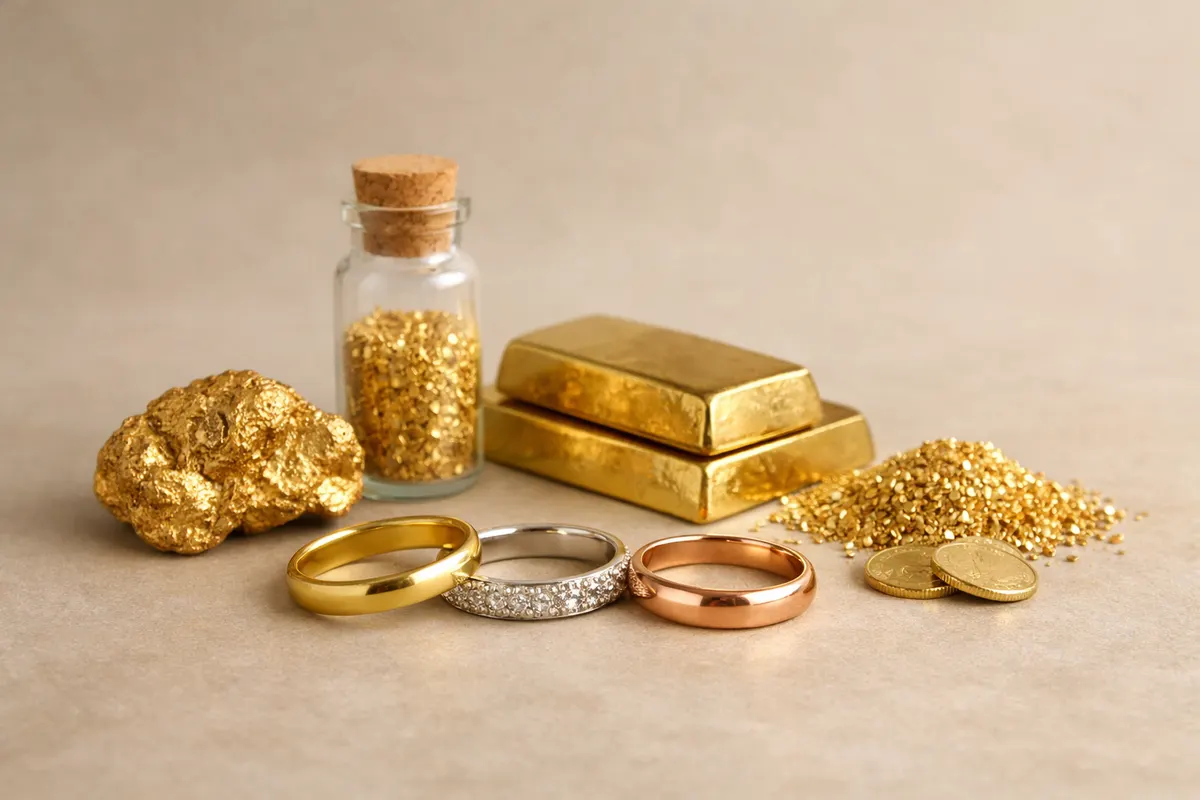
Quick answer: How to tell different gold types
Gold types include natural gold (native gold), native nuggets and flakes, refined bullion and jewelry of various karats, gold-plated or gold-filled items, and lookalikes such as pyrite or brass. The simplest quick checks are color, weight, and whether a hallmark or karat stamp is present; these clues together usually separate solid gold jewelry from plated pieces, but they’re not definitive on their own.
A short photo inspection can narrow possibilities: warm, consistent yellow tones, heavy feel for size, smooth edges on rings, and clear hallmarks point toward solid or higher-karat gold, while bright brassy color, flaky surfaces, or magnetic attraction indicate likely lookalikes or plated items. If you need a confident answer for sale, appraisal, or recycling, follow up with an acid test, XRF analysis, or a trusted assay—photos alone are not enough.
- Solid gold (10K–24K): consistent color, non-magnetic, denser/heavier than lookalikes.
- Gold-plated / gold-filled: thinner gold layer over base metal; often lighter and shows wear at edges.
- Natural gold ore and nuggets: irregular shapes, often duller and mixed with rock matrix.
- Pyrite/brass lookalikes: brighter brassy hue, brittle or flaky texture, may be magnetic if mixed metals present.
- When in doubt: confirm with chemical tests, professional assays, or a reputable scrap-value calculator.
What we mean by different gold types
When people ask about gold types they usually want to know whether an object is solid gold, gold-plated, gold-filled, or simply a lookalike material. Solid gold refers to pieces where the metal throughout is an alloy of gold and other metals; karat marks (10K, 14K, 18K, 22K, 24K) indicate the proportion of pure gold. Gold-plated pieces have a thin layer of gold bonded to a base metal; gold-filled items have a thicker mechanically bonded layer but are still not solid gold.
Natural gold forms in veins, flakes, or nuggets and appears as part of rock or sediment. That material is different from refined bullion and jewelry because it contains other minerals and is not melted and alloyed for wear. Understanding these distinctions helps you pick the right visual checks and tests: e.g., color consistency and hallmarks matter more for jewelry, while density and matrix context matter more for ore and nuggets.
For value and recycling purposes, 'gold types' also covers karat (purity) differences: higher karats have more gold content and different color tones. But remember that color and karat are not one-to-one: lower-karat alloys can be made to look like higher-karat pieces with plating or finishing, so you need combined evidence—not color alone—to estimate type and purity.
- Solid gold = alloyed metal throughout; marked by karat stamps and heavier weight.
- Gold-plated = thin decorative layer, wears at high-contact points.
- Gold-filled = thicker layer, usually hallmarked differently than plating.
- Natural gold (ore/nuggets) = irregular, often mixed with rock; requires geological context.
- Karat indicates purity but must be verified with tests for resale or appraisal.
Gold visual clues to identify types
Color and tone are the first visual clues: higher-karat gold (18K–24K) tends to be richer and warmer in yellow, while lower-karat gold (10K–14K) can look paler or slightly more “white” because of the alloyed metals. Gold-plated surfaces sometimes have unnaturally bright or uniform finish that wears off near edges, seams, and prongs—look there for exposed base metal.
Surface texture and wear patterns reveal manufacturing and use. Solid gold alloys show consistent color through scratches and inside crevices; plating frequently reveals a different base metal color under wear. Natural gold ore and nuggets will have irregular, often granular surfaces and may be attached to rock—these textures differ from polished manufactured pieces.
Hallmarks, stamps, and maker’s marks are essential visual evidence. For jewelry, look inside rings, on clasps, or on the back of pendants for numbers like 375, 585, 750, 900, or 999 and karat marks like 9K/14K/18K. Keep in mind that stamps can be faked; a genuine hallmark increases confidence but does not guarantee purity without testing.
- Color tone: warm, deep yellow suggests higher-karat; pale yellow or slightly reddish tones indicate specific alloys.
- Density feel: heavy for size commonly indicates genuine gold alloys.
- Wear points: check rims, clasps, and prongs for base metal showing through.
- Stamps: karat numbers and millesimal fineness (e.g., 585 for 14K) are useful but not foolproof.
- Texture: natural nuggets and ore are irregular; manufactured pieces have consistent, finished surfaces.
Step-by-step workflow for identifying gold types
Start with a careful visual and tactile inspection: note color, weight (how heavy it feels for its size), hallmarks, and areas of wear. Photograph the item from multiple angles—close-ups of any stamps, the edge of rings, the back of pendants, and any seams or solder marks. Good photos help freeze evidence and let you compare against reference examples or ask for a remote opinion.
Next, perform safe non-destructive at-home checks. Use a magnet to rule out strongly magnetic base metals (gold is not magnetic). Try a simple density comparison: if you have a precise scale and a small water container, measure weight and volume to calculate specific gravity; solid gold will be notably denser than brass or copper. A visible rubbed area or a light scratch can reveal a different color under a plating layer—observe closely.
If those checks leave doubt, move to minimally invasive tests. An acid spot test kit (for karat approximation) can indicate relative purity when used correctly but requires practice and caution—avoid on highly sentimental pieces. For sale, recycling, or legal purposes, get a professional XRF or fire assay for definitive karat and fineness measurements. Document test results and provenance before accepting an offer or sending items for refining.
- 1) Photograph multiple angles with scale and context.
- 2) Check hallmarks, weight, and wear points visually.
- 3) Use a magnet to rule out ferrous metals.
- 4) Do a simple specific gravity check if you can weigh and submerge safely.
- 5) Use acid testing cautiously or refer to XRF/fire assay for final confirmation.
Practical examples showing common gold-type scenarios
Example 1 — An old ring found at home: It has a faint '375' stamp inside, a slightly dull yellow tone, and light wear on the band edges. These clues suggest 9K gold (37.5% gold) or a plated surface hiding a stamp. Follow the step-by-step checks: photograph the stamp, weigh the ring, try a magnet, and if still uncertain consider a quick acid spot test or a local jeweler’s XRF scan before selling or scrapping.
Example 2 — A bright, heavy pendant from a thrift store: The pendant feels weighty and has a uniform warm tone, with '750' stamped on the bail. That mark points toward 18K (75% pure gold). Confirm by checking for consistent color in crevices and, if the value matters, a non-destructive professional assay. High-karat items often carry hallmark clusters (maker, assay office, purity) that add verification.
Example 3 — A shiny metallic rock from a creek: It has a brassy sheen and brittle flakes that break off easily. Many people mistake pyrite for gold, but the texture and crystal-like breakage here point to pyrite. For geology and outdoor finds, context matters: surrounding rock, weight compared to similar-sized specimens, and fracture patterns help separate natural gold from lookalikes. For more on that comparison, see the related internal guide: Gold vs Pyrite: Visual Clues, Lookalikes, and Next Steps (https://golddetector.app/blog/gold-vs-pyrite).
- Old stamped ring: stamps + wear = check weight and acid test if resale is planned.
- Heavy warm-toned pendant: 750 stamp likely 18K—verify with professional test.
- Creek rock: brassy, brittle = likely pyrite; use geological context and specific gravity.
- Thrift finds: always document stamps and perform non-destructive checks before selling.
Limitations
Photos and visual checks are useful triage tools but rarely provide final certainty. Lighting, camera white balance, surface reflections, and image compression can alter color perception. Plating and surface treatments are especially deceptive in photos: a picture may show a perfect finish that hides worn edges or different underside colors, and small hallmarks can be missed or forged in low-resolution images.
Non-specialist at-home tests also have limits. Magnets and sight checks can rule out obvious fakes, but they can’t measure exact karat. Acid tests give a rough purity reading but risk damage and are user-dependent. For financial decisions—selling, buying, or refining—rely on a trusted assay or XRF scan, which provide lab-grade measurements. When value or legality is at stake, treat photographic evidence and quick checks as preliminary, not conclusive.
Know when to call a professional: suspected high-value items, complex alloys, antiques with repair or plating, or pieces with questionable provenance should be inspected by a jeweler or assay house. Keep documentation for provenance and test results. If you plan to recycle or sell scrap, use the gold calculator (linked below in the next steps) to estimate value only after you have a verified purity reading.
- Photos can mislead—lighting and compression change color.
- Hallmarks can be faked; they increase confidence but aren’t conclusive.
- At-home acid tests are approximate and can damage fragile items.
- High-value or ambiguous items should get professional XRF or fire assay verification.
- Use tests and documentation before selling, refining, or making legal declarations.
Related guides
Next step: confirm purity and estimate scrap value
If you want an evidence-backed scrap estimate after your visual checks, use the Gold Karat, Purity & Scrap Value Calculator at https://golddetector.app/tools/gold-calculator. Treat the calculator as a value estimator to use after you have a verified purity result (hallmark plus test or professional assay). The app and tools can serve as a first-pass triage, but for high-value or uncertain pieces, get an XRF or assay report before committing to sale.
Take the next step →Frequently asked questions
How can I perform a basic at-home gold identification guide for a ring I found?
For a ring you found, start by photographing both sides with a ruler for scale. Look for stamps (e.g., 375, 585, 750, or karat marks) inside the band, then check weight and use a magnet to see if it’s attracted (gold is not magnetic). If you can safely measure volume and weight, calculate specific gravity to compare against gold’s density. If uncertainty remains, avoid destructive testing on a sentimental piece—visit a reputable jeweler for an XRF scan or professional opinion. Document any marks and test results before selling or sending it for assay.
What visual signs should make me suspect an item is gold-plated rather than solid gold?
Look for wear at high-contact points—edges, clasps, the back of pendants, and prongs—where a different base metal color shows through. Plated items sometimes have a unnaturally bright finish or uniform color that contrasts with rougher inner surfaces. Lightweight feel for size and lack of a clear karat or fineness stamp also suggest plating. A close-up photograph of worn areas usually reveals the base metal tone under the plating.
Which quick tests reliably separate gold types from lookalikes like pyrite?
Start with color and texture: pyrite has a brassy sparkle and often forms crystals or flaky fragments, while gold is malleable and shows smooth bends or flattened surfaces when struck. Use a magnet to rule out strongly magnetic materials, and compare density—gold is significantly denser than most lookalikes. For creek finds, consider the geological matrix: gold often occurs with quartz and heavy mineral concentrations. If a quick check leaves doubt, a specific gravity test or professional assay is the reliable next step.
When should I get a professional assay instead of relying on visual checks or photos?
Get a professional assay when the item has potential significant monetary value, is being sold or bought for scrap or refinement, or when provenance and legal documentation matter (estate settlement, customs, or insurance). Also choose an assay if you have conflicting clues—clear hallmarks but odd weight, or high visual quality with suspicious stamps. Professionals use XRF or fire assay methods that quantify karat and fineness; keep their report with any sale or refinement paperwork.