

Pyrite vs Gold: How to Tell the Difference Quickly
Quick, practical advice for distinguishing pyrite vs gold using color, luster, texture and simple tests. Photo limits, next checks, and safe next steps.
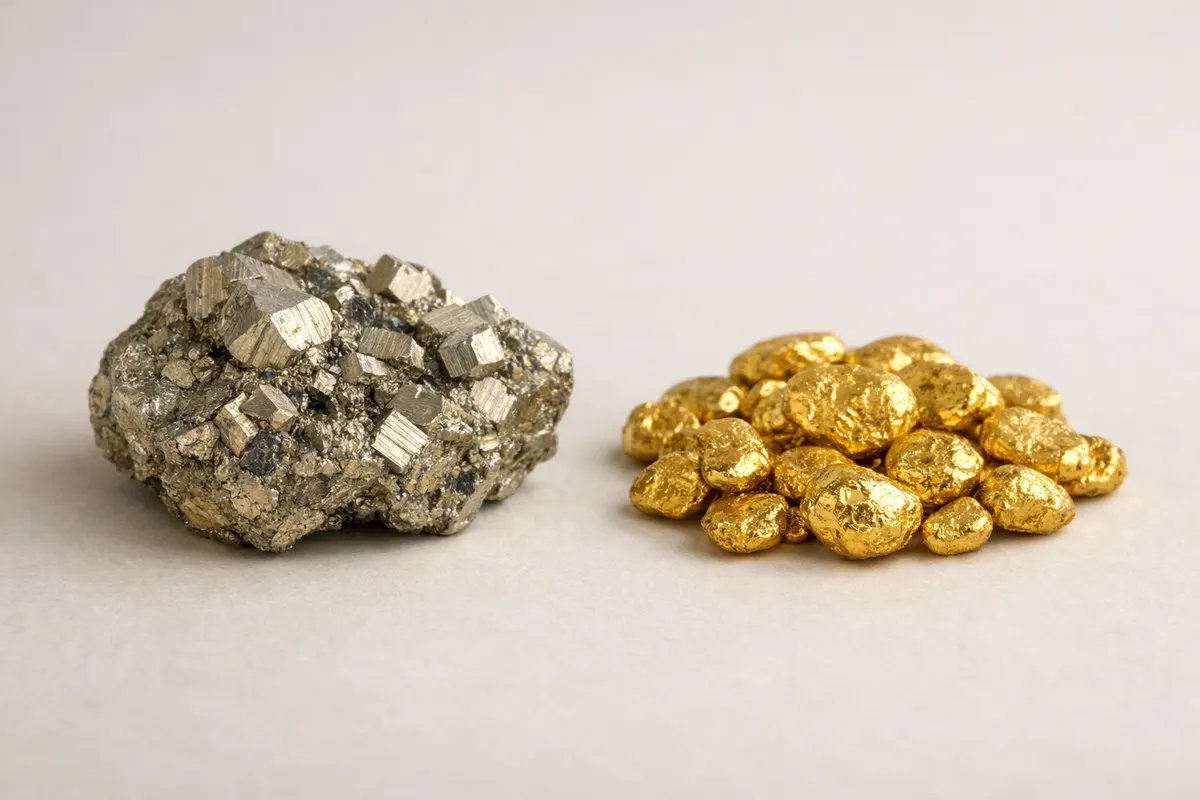
Quick answer: spotting pyrite vs gold
Pyrite vs gold can often be separated by a few consistent visual and physical traits. Gold is a soft, dense, malleable metal with a warm, buttery yellow color and a metallic luster that stays consistent across worn surfaces. Pyrite (commonly called “fool’s gold”) is a brittle iron sulfide that often looks brighter, paler, and more brassy; it commonly forms small cubic crystals or aggregates rather than smooth, malleable surfaces.
In a single photo you can get a strong initial impression: gold tends to appear richer, deeper yellow and may show wear revealing a consistent interior color. Pyrite often shows sharper geometric facets, crystal faces, or a sparkly granular texture. But a photo alone isn’t definitive. A few safe at‑home checks—weight, streak, hardness, and a simple magnet test—usually separate the two without specialized tools.
If you need a quick rule of thumb: if the piece dents or bends easily and feels unusually heavy for its size, it’s likely gold; if it flakes, chips, or reveals sharp cubic crystals, it’s likely pyrite. When in doubt, treat the photo as preliminary evidence and follow the step‑by‑step checks below before assigning value or authenticity.
What pyrite and gold are — gold types and context
Understanding what each material actually is helps you read visual cues correctly. Native gold is elemental gold (Au): a naturally occurring metal that is malleable, dense, and chemically nonreactive. In everyday contexts you’ll encounter gold as nuggets, flakes, or as alloys and jewelry with mixed metals. That spectrum of real-world forms is what people mean when they think about different gold types.
Pyrite is an iron sulfide mineral (FeS2) that forms in a variety of geological settings—veins, sedimentary beds, and hydrothermal deposits. It commonly develops well-defined cubic or pyritohedral crystals and often occurs in association with other sulfides. Because pyrite is a mineral rather than a native metal, its fracture, brittleness, and crystal habit differ sharply from gold’s ductile behavior.
The practical takeaway: gold types can include pure native gold, natural alloys, and manufactured jewelry alloys (which change color, weight, and malleability). Pyrite will never behave like a metal in terms of bending or leaving consistent gold-colored streaks; its physical and structural differences create the most reliable visual and tactile distinctions.
Gold visual clues to check first
When you only have a photo or a small sample, prioritize a short checklist of high‑signal clues. Use a combination of color nuance, luster behavior, texture detail, crystal habit, and context (where the specimen came from) to form an initial opinion. Each clue has limits, so use more than one before concluding.
Color and hue: look for a warm, deep yellow that stays the same on exposed and scraped surfaces. Pyrite often looks paler, brassy, or more silvery under bright light. Lighting and photo white balance can mislead here, so pair color with other clues.
Luster and reflectivity: gold has a soft metallic sheen that reflects broadly; pyrite often gives sharper, mirrorlike reflections from small crystal faces. In photos, points of specular reflection that resemble tiny mirrors often mean crystal faces—favoring pyrite.
- Crystal habit: cubic or geometric facets strongly suggest pyrite; rounded, nugget-like shapes suggest native gold.
- Streak color: on unglazed porcelain, gold leaves a yellow streak; pyrite leaves a gray‑black streak. (Do not damage valuable jewelry to test.)
- Hardness feel: gold is soft (can be scratched or dented by a steel knife); pyrite is harder and brittle, often shattering or flaking.
- Malleability: gently press or try to bend a tiny flake—gold bends and flattens, pyrite will snap or crumble.
- Density/weight: gold feels notably heavy for its size. If a small piece is unexpectedly light, it’s less likely to be gold.
- Magnet test: pyrite is not strongly magnetic, but magnetic attraction suggests iron minerals or contamination—not gold.
Step-by-step workflow to check pyrite vs gold safely
Use the following ordered checks when you have a specimen or a clear set of photos. Start with noninvasive visual observations, then move to low‑risk physical tests if you can handle the sample. Stop and seek professional help if the item is valuable or historically important; the steps below are meant for initial triage, not final valuation.
Step 1—Visual pass: inspect under daylight or neutral light. Look for consistent interior color, crystal faces, and edge behavior. A loupe or magnifying glass helps reveal granular texture versus smooth metal surfaces.
Step 2—Streak test (if appropriate): gently drag a small, inconspicuous edge across unglazed porcelain to see the streak color. Gold produces a yellow streak; pyrite produces a dark gray to black streak. Skip this on finished jewelry or items you cannot afford to mark.
- Step 3—Hardness check: use a steel knife to attempt a light scratch in a hidden area. Gold (softer) will show a scratch or indentation; pyrite (harder) resists scratching but may crumble.
- Step 4—Malleability test: with a tiny flake, use pliers to bend. Gold will deform; pyrite will often break.
- Step 5—Weight assessment: compare the item’s heft to a similar-sized metal or rock. Gold’s high density is one of the clearest tactile clues.
- Step 6—Magnet and visual recheck: a strong magnet attracting the piece indicates iron content or contaminants. Re-evaluate texture and any coatings that could disguise base metals.
- Step 7—When to stop and verify: if tests conflict or the item is valuable, consult a jeweler, assay lab, or a qualified mineralogist for density tests or XRF analysis.
Examples
Loose pan‑gold nugget in a prospecting photo: true nuggets are usually rounded, irregular, and show smooth surfaces where they’ve been tumbled. They look rich in color and feel heavy. If the photo shows many small shiny crystals or very angular geometry, that points toward pyrite or other sulfides.
Small flake on old jewelry: in photos of ring filings or flakes, look for a consistent interior color when edges are exposed. Flakes that bend or have rolled edges in macro photos are more likely gold. If the close‑up shows flat crystal faces or a glittering granular surface, suspect pyrite or brass fragments.
Decorative jewelry with bright brassy plating: plated or gold‑colored base metals are frequent lookalikes. Photos may show uniform yellow similar to gold but plated items often reveal base metal at worn edges or under jump rings. A simple handheld test (weight and malleability) helps; plated pieces are lighter and will not behave like solid gold.
- Example 1 — Prospecting photo: angular, sparkly fragments = pyrite; smooth, heavy nuggets = gold.
- Example 2 — Jewelry close‑up: peeled plating and exposed base metal indicate plated brass; look for consistent interior color to confirm real gold.
- Example 3 — Ore samples: gold is usually found as visible flakes in quartz or as tiny rounded grains, while pyrite appears as discrete metallic cubes.
Limitations
Photos are inherently limited. Lighting, camera white balance, compression artifacts, reflections, and scale all distort color, texture, and perceived weight. A shiny speck in a photo can look like gold under warm light but be brass, mica, or pyrite in person. Treat photographic evidence as a starting point, not a conclusion.
Some materials intentionally mimic gold: gold plating, gilt, brass, and certain sulfides or mica coatings can hide a different core. Gold alloys (the gold types discussed earlier) change color and hardness depending on purity and alloying metals; lower‑karat gold looks paler and can confuse visual checks.
Certain tests carry risks. Acid or nitric tests can damage samples, and home chemical tests involve hazards and potential legal or safety issues. For anything valuable—antique jewelry, coinage, or significant prospecting finds—stop after noninvasive checks and seek professional assay or lab verification.
- High confidence outcomes: consistent heavy weight, malleability, and yellow streak strongly indicate gold.
- Partial outcomes: mixed signals (heavy but crystalline surface) require density measurements or lab tests.
- Uncertain outcomes: photos with poor scale or lighting—seek expert inspection or XRF/density testing.
Related guides
Ready for a closer look? Use an expert photo check
If you’ve done the quick checks and want a second opinion, use Gold Detector - Goldiva as one optional next step to review photos and get structured feedback. Treat an app check as preliminary—helpful for triage but not a substitute for lab assays or a jeweler’s inspection when value or authentication matters. Visit https://golddetector.app/ to learn how the tool works and to choose the verification path that fits your find.
Take the next step →Frequently asked questions
Where can I find a gold identification guide for a photo of jewelry?
If you’re working from photos, start with a structured checklist: check color under neutral light, look for exposed interior color at worn edges, inspect for plating at joins or clasps, and assess shape—nuggets versus crystals. Use noninvasive tests first (weight feel, magnified texture). For a definitive answer on valuable pieces, a jeweler or assay lab can run XRF or an acid test safely. You can also consult focused online guides and tools that walk through photo-based checks before deciding on lab verification.
How accurate is a magnet test when I’m comparing pyrite vs gold?
A magnet test is a quick sanity check but not definitive. Native gold is not magnetic; it will not be attracted to a magnet. Many iron-containing minerals and some cheap metallic fakes will react. However, pyrite itself is only weakly magnetic or nonmagnetic; strong attraction usually points to other iron minerals or ferromagnetic contamination rather than confirming pyrite. Use magnet tests alongside streak, hardness, and weight checks rather than as a single proof.
Can a streak test damage an item I suspect is gold?
A streak test requires dragging the specimen on unglazed porcelain, which can leave a visible mark. Avoid this on finished jewelry, coins, or items you don’t want marked. For loose rocks, prospecting finds, or scrap metal, a streak test is a low‑cost, high‑signal check: gold gives a yellow streak, pyrite leaves a dark gray to black streak. If the object is valuable or historic, opt for noninvasive methods and professional appraisal.
What are common lookalikes that make pyrite vs gold confusing?
Many materials imitate gold’s color or sparkle. Brass and bronze have a brassy tone and can be mistaken for gold in photos; gilt plating hides base metal underneath; mica and certain sulfide minerals produce glittery reflections similar to pyrite’s sparkle. Additionally, low‑karat gold alloys can appear paler and be mistaken for brass or pyrite in poor lighting. Combining texture, crystal habit, streak, malleability, and weight checks reduces misidentification risk.